Published in Tutorials
Market Research Report Example: Template + AI Prompts

A useful market research report answers a decision: which customers to pursue, which problem to solve, or whether an opportunity deserves investment. It connects evidence to a recommendation and makes the uncertainty visible.
Below, you'll find a worked market research report example, a free editable template, and three AI prompts for building your own. The example follows a small software company deciding whether to test a scheduling product with commercial cleaning businesses.
Start with the template: Download the free market research report template. It's a Markdown file you can open in a text editor or copy into your document editor. No signup required.
Jump to: Worked example · Free template · AI prompts
What should a market research report include?
A practical report needs seven sections. Together, they explain the question, the evidence, and the action the reader should take.
| Section | What it should answer |
|---|---|
| Executive summary | What did we learn, and what should happen next? |
| Scope and methodology | Who, where, and what period did we research? How? |
| Customer findings | What problem exists, who feels it, and what do they do today? |
| Market opportunity | How many relevant buyers might exist, under which assumptions? |
| Competitive alternatives | What would customers use or buy instead? |
| Recommendations | Which action follows from the findings? |
| Sources and limitations | Where can readers check claims, and what remains unknown? |
These sections don't need equal space. A customer-discovery report may devote most of its pages to interviews. A market-entry report may need deeper coverage of competitors and geography. Keep the decision visible as you choose what to include.
The U.S. Small Business Administration's planning guidance identifies demand, market size, location, saturation, and pricing as useful research questions. It also distinguishes existing sources from direct research such as surveys and interviews. Use those questions to plan your investigation; don't fill every section with a generic industry overview.
Market research report example: a scheduling product
Illustrative example: The company, interviews, source IDs, observations, and financial inputs in this section are fictional. They demonstrate report structure, not actual market evidence or investment advice. Replace them with verified research in your own report.
1. Executive summary
Decision: Should a small software team test a shift-change product with U.S. commercial cleaning businesses employing 10–50 people?
Finding: In this fictional discovery exercise, six of eight interviewed owners describe last-minute staffing changes as a recurring problem. Three agree to discuss a pilot. Those signals justify further testing, but they do not establish broad market demand or willingness to pay.
Recommendation: Run a four-week pilot with three businesses before committing to a wider launch. Focus on assigning replacement staff and confirming that they received the update. Measure coordinator time, missed assignments, and willingness to continue at a stated price.
Main uncertainty: Businesses may prefer to keep using messaging apps, even when coordination is inconvenient. The pilot must test whether the improvement is worth changing their workflow.
2. Scope and methodology
The target segment is owner-managed U.S. commercial cleaning businesses with 10–50 employees. The proposed product covers shift changes and acknowledgments. Payroll processing, recruiting, and large-enterprise workforce planning are outside scope.
The fictional research consists of eight owner interviews recruited through one local business network, a review of three categories of alternatives, and a planning model using assumed account counts and prices.
This is an exploratory convenience sample. It may overrepresent owners already interested in software. The report does not claim that six of eight interviewees represents the wider market, and pilot interest is not treated as a purchase commitment.
3. Customer findings
Use a findings table to separate what someone observed from what the team thinks it means.
| Fictional observation | Interpretation | Next check |
|---|---|---|
| Six of eight owners describe recurring shift changes. | Coordination may be a frequent problem. | Record actual changes during the pilot. |
| Four describe checking several message threads. | Confirmation may be as valuable as scheduling. | Test a single acknowledgment view. |
| Three agree to a pilot discussion. | Recruiting an initial test group may be feasible. | Ask for a start date and named coordinator. |
The proposed first buyer is the owner or operations manager who handles changes. Employees are users whose experience affects adoption. Interview both groups before settling on the workflow: a tool that saves the owner time could still create extra work for employees.
4. Market opportunity and assumptions
For an early report, a transparent scenario can be more useful than an impressive total-market number. Here is a deliberately simple model with invented inputs:
- Assumed eligible accounts in a defined launch territory: 2,000.
- Assumed annual subscription price per account: $600.
- Annual revenue pool if every eligible account bought: 2,000 × $600 = $1.2 million.
- Separate sales scenario: 50 paying accounts × $600 = $30,000 annual recurring revenue.
The $1.2 million figure is an illustrative opportunity calculation. The $30,000 figure is a sales scenario. Neither is a forecast, and the report has not validated the account count, price, acquisition cost, or churn.
In a real report, state the source and year for the account count, check whether those businesses meet your buying criteria, and support pricing with customer evidence. Keep sensitivity visible: changing the assumed price to $400 would reduce the same 2,000-account revenue pool to $800,000.
The Census Bureau's Statistics of U.S. Businesses program provides employer-business statistics by geography, industry, and enterprise size. Check whether a table counts firms or establishments and which businesses it covers. A business count still needs filtering before you can treat it as a pool of potential software customers.
5. Competitive alternatives
Compare the customer's options, including doing nothing. This example uses categories to investigate, not verified product ratings.
| Alternative | Why a buyer might keep it | What to investigate |
|---|---|---|
| Spreadsheet plus messaging app | Familiar tools with little setup | Time spent updating and confirming changes |
| General scheduling software | A broader set of scheduling features | Setup effort, mobile use, and current price |
| Payroll-linked workforce system | Existing vendor relationship | Workflow fit and integration requirements |
For a real competitor matrix, record the product, plan, URL, and date checked. Separate vendor descriptions from behavior you actually tested. A missing feature on a marketing page is not proof that the product lacks it.
6. Recommendation and decision criteria
Proceed with a limited pilot. Assign one product lead to collect a baseline, support setup, and review results after four weeks.
Use these illustrative decision criteria, agreed before the pilot begins:
- At least two of three businesses use the workflow each week.
- Those businesses reduce coordinator time per shift change by at least 20% against their own baseline.
- At least two accept a paid continuation at the tested price.
These are proposed internal gates, not industry benchmarks. If usage is consistent but nobody will pay, revisit the buyer or price. If employees fail to acknowledge changes, improve that workflow before expanding the product.
7. Sources, gaps, and limitations
A report needs a trail back to the underlying material. In this fictional example, the source register would look like this:
| Example source ID | Material to retain | Limitation |
|---|---|---|
| INT-01 to INT-08 | Dated interview notes and participant roles | Small sample from one network |
| COMP-01 to COMP-03 | Dated comparison notes and links | Product behavior still needs testing |
| MODEL-01 | Account, price, and sales assumptions | Inputs are unvalidated |
The next research round should recruit beyond the original network, include employee interviews, and test price with a concrete offer. Do not turn an unverified assumption into a finding simply because it appears in a formatted report.
Adapt the free market research report template
The downloadable template follows the same seven-section structure. It includes empty findings and competitor tables, a market-sizing worksheet, a source register, and decision criteria. There are no prefilled market claims to accidentally reuse.
Start by completing this brief:
Decision this report must support:
Reader and decision deadline:
Product or service being considered:
Target customer and geography:
Research period:
What is outside scope:
Sources already available:
Questions we cannot answer yet:
Then populate the evidence sections before writing the executive summary. Every recommendation should connect to a finding, a constraint, or an explicitly stated assumption. If the research changes your initial view, change the recommendation too.
Keep the main report focused. Put long interview extracts, detailed calculations, and full comparison sheets in an appendix. The reader should be able to find the proposed action and its supporting evidence without searching through every research note.
Three AI prompts for writing your report
AI can help organize source material, draft sections, and challenge unsupported statements. Check its output against the originals. Upload only material you are authorized to use, and remove unnecessary personal or confidential details.
Prompt 1: Build an evidence table
Use this before asking for a complete draft:
I am researching [decision] for [audience], covering
[customer segment], [geography], and [research period].

Use only the source material I provide. Create an evidence
table with: claim, source ID, page or section, source date,
population/geography, and limitation.

Separate observations, calculations, and assumptions.
Flag conflicting definitions or time periods. Mark missing
information as unknown. Do not invent quotes or sources.
Finish with the five unanswered questions most likely
to change the decision.
Prompt 2: Draft the report from checked evidence
After reviewing the evidence table, provide it with your brief:
Draft a market research report using my approved brief
and evidence table. Include: executive summary, scope
and methodology, customer findings, market opportunity,
competitive alternatives, recommendations, and limitations.

Attach source IDs to factual claims. Label every assumption
and show the inputs and arithmetic for each calculation.
Do not extrapolate interview percentages to the whole market.

Use concise paragraphs and descriptive headings. End with
a proposed action, owner, measurement plan, and decision gate.
If the evidence is insufficient, recommend the next research
step instead of asserting that the market is attractive.
Prompt 3: Audit the draft
Give the AI the draft and original sources, not just its earlier summary:
Review this report against the supplied sources. List:
1. Claims without supporting evidence.
2. Numbers with incompatible scope, units, or dates.
3. Assumptions written as established facts.
4. Recommendations that do not follow from the findings.
5. Important uncertainty missing from the executive summary.

For each issue, identify the passage, explain the problem,
and suggest a correction or additional research. Do not
invent missing evidence or silently alter source figures.
For a more detailed citation workflow, see how to build AI reports with citations. If your evidence is mostly PDFs, use the PDF-to-report workflow to organize the files before drafting.
Turn the research into an editable report
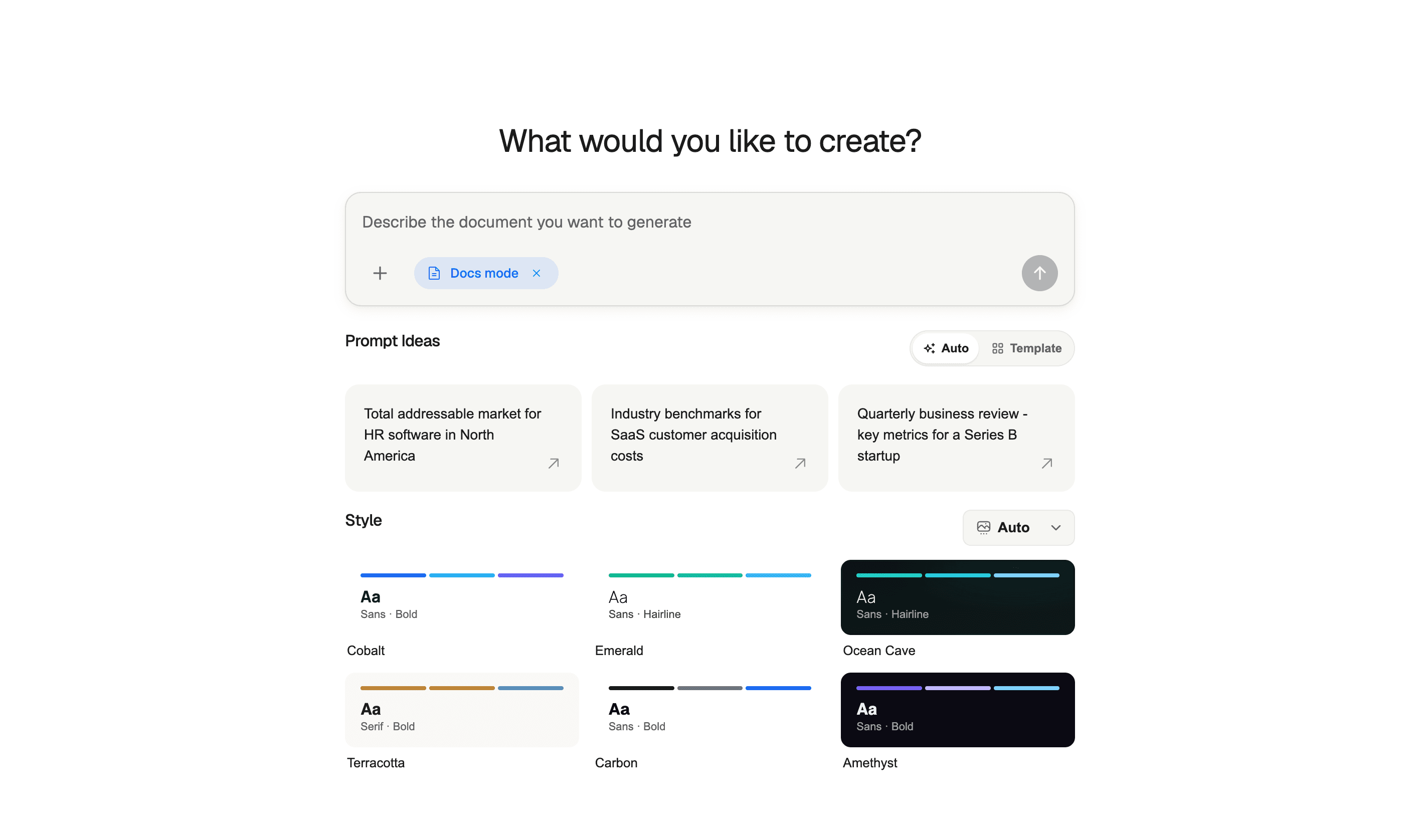
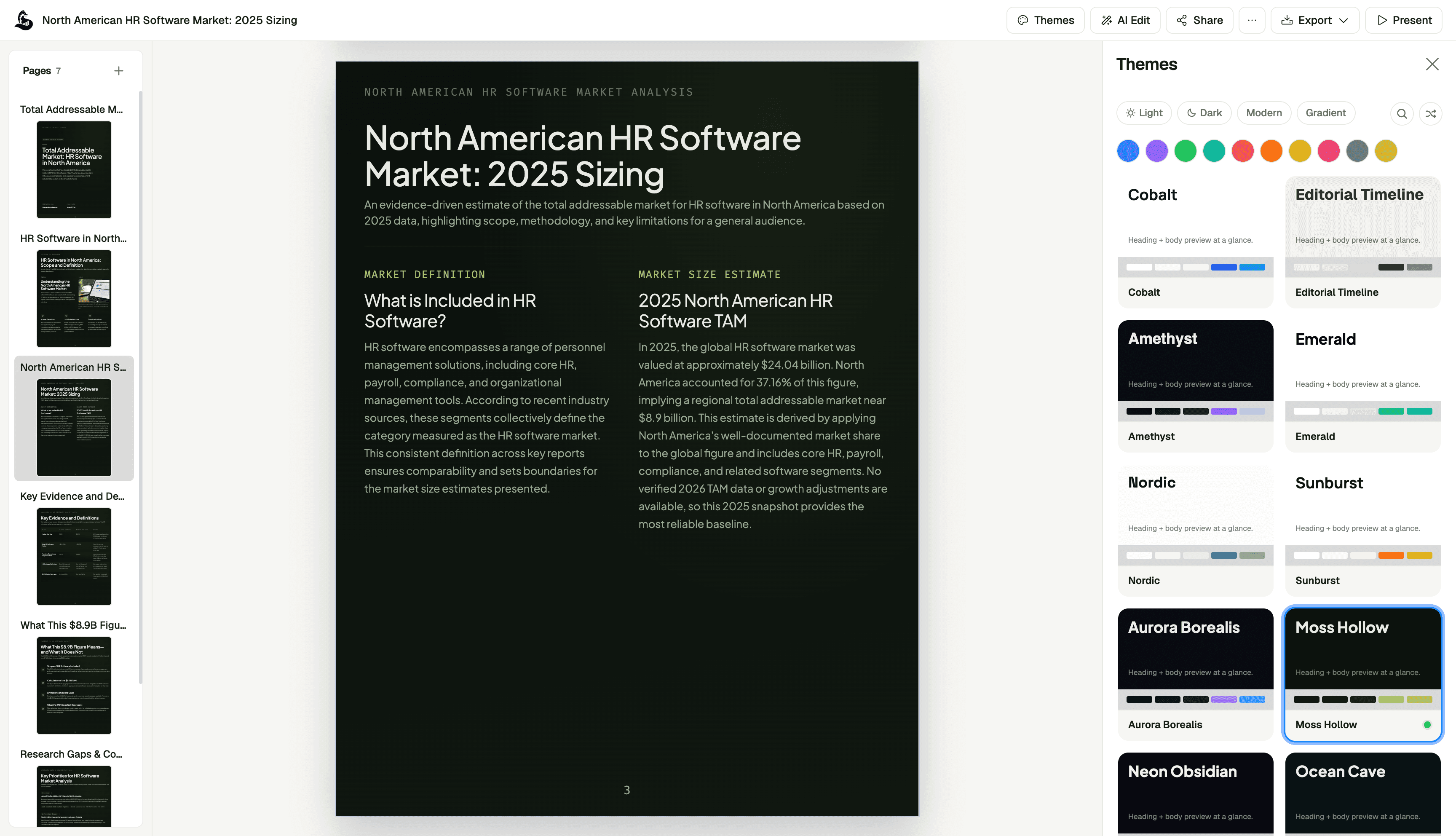
Once the evidence and structure are ready, you can use ML Clever's AI document tools to turn your prompt and source files into an editable document. Review the content, adjust the layout and theme, and prepare the report for sharing or export.
The market research playbook outlines that workflow. Keep the source register with your report, and check tables, citations, and page breaks in the final output. Formatting is the last review layer; it cannot resolve missing evidence.
Frequently asked questions
How long should a market research report be?
Match the length to the decision and evidence. For a focused internal brief, a useful starting format is a one-page executive summary plus short findings sections and an appendix. Expand when readers need more methodology, segment comparisons, or calculations. There is no reason to add pages that don't help evaluate the recommendation.
What is the difference between market research and market analysis?
For this template, market research is the process of gathering evidence about customers, demand, and alternatives. Market analysis is the interpretation of that evidence: what it means for the opportunity, positioning, and next decision. A report can contain both.
Can I use AI to write a market research report?
Yes. Use it to organize evidence, propose an outline, and draft from checked sources. Verify calculations, inspect cited passages, and keep assumptions labeled. AI-generated interviews, invented citations, or unsupported market figures cannot substitute for research.
Is the template free and editable?
Yes. Download the Markdown template, open it in a text editor, or copy it into your preferred document tool. You can adapt the sections and tables without creating an account.
Created with AI assistance. The worked example is fictional; linked public sources support the research-method guidance. The cover is an original AI-generated illustration, not a screenshot or a data visualization of real findings.

ML Clever Team
Product Team
Get new ideas in your inbox.
Practical AI workflows and product notes from ML Clever.