Ask your data anything
Upload your spreadsheet, ask questions in plain English, and get instant answers complete with charts and explanations—no SQL or waiting required.
Best-performing products ranked by net revenue:
Quick insight: Business leads revenue at $40.3k, while Starter is unprofitable despite high volume — consider pricing review.
See how the analyst thinks
Transparent views of prompts, filters, and reasoning steps.
Web Research
Live research for effective results.
Suggested prompts
Ready-made questions to explore faster.
Python insights
Transparent logic alongside results.
Trusted Logic
Watch the AI plan, analyze, and explain its reasoning in real-time so you can verify the results.
Deep Exploration
Drill down into your dashboard by asking follow-up questions, requesting new breakdowns, or investigating anomalies instantly.
Revenue by Segment
Monthly breakdown · YTD 2024
SELECT
  DATE_TRUNC('month', created_at),
  segment,
  SUM(revenue) AS total
FROM sales_transactions
GROUP BY 1, 2
ORDER BY 1;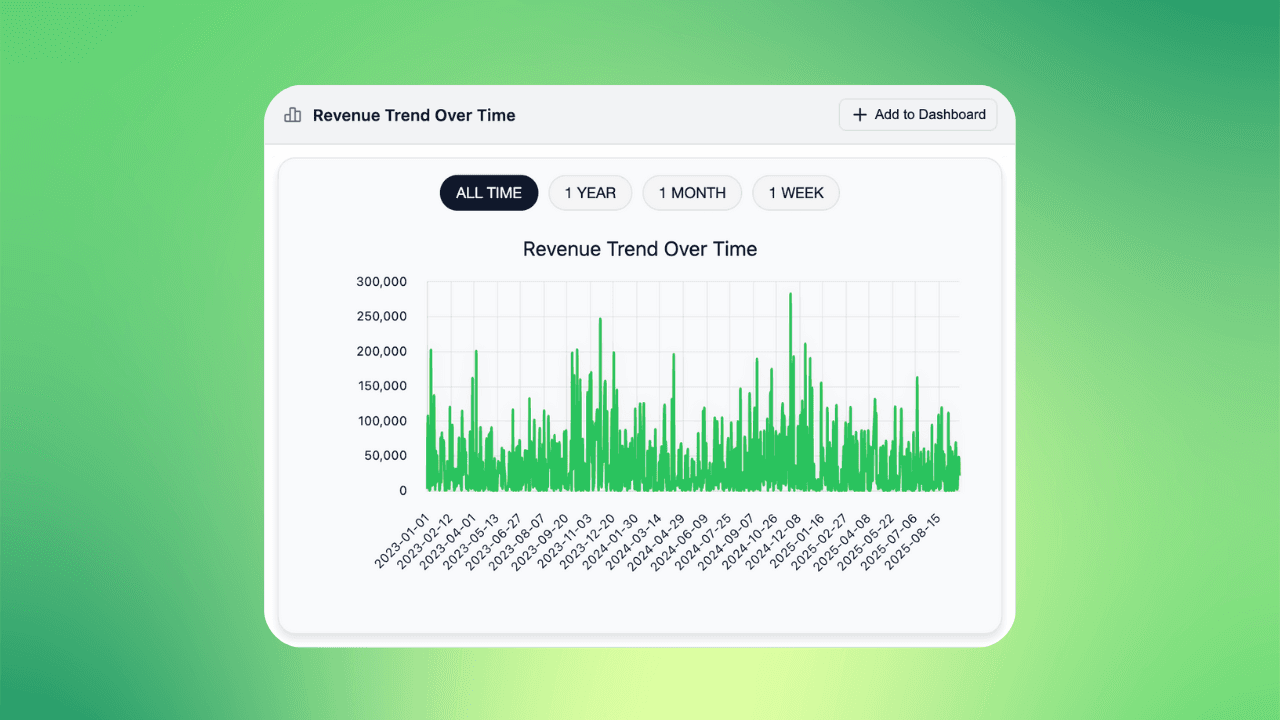
Ask in plain English
No SQL or special syntax needed. Ask questions just like you'd ask a colleague: 'Which customers churned last month?'
Get charts, not just numbers
Every response includes the right visualization automatically—bar charts for comparisons, line charts for trends, and tables for details.
Keep the conversation going
Ask follow-ups naturally. Say 'break that down by segment' and watch the analysis evolve instantly.
Analysis that adapts to you
Smart Visualizations
AI automatically selects the best format: bar charts, line graphs, or data tables.
Multi-Step Reasoning
Complex questions are broken into logical steps to synthesize accurate answers.
Written Explanations
Get context on what the numbers mean, what stands out, and what to explore next.
Save to Dashboards
Found an insight? Save any chart to a live dashboard with one click.
Smart Context
The AI reads your specific data structure to plan the right approach and explain exactly what it found.
Here's your monthly revenue comparison for 2024 vs 2023:
YoY Growth
+36.5%
Best Month
June
Avg Growth
+$5.2k
Quick insight: Revenue accelerated in Q2, with June showing the strongest YoY delta (+$19k). Growth rate increased from 20% in Jan to 36% in June — momentum is building.
Ask anything about your data
"What were our top products last quarter vs last year?"
AI runs the comparison, builds the chart, and highlights growth.
"Which customer segments have the highest churn?"
AI calculates churn by group and surfaces risk patterns.
"Break down expenses and flag growth over 20%."
AI categorizes spending and calls out line items needing attention.
"What's our average fulfillment time by warehouse?"
AI ranks locations and identifies where delays originate.
"Compare conversion rates across channels."
AI builds a multi-channel comparison with trend analysis.
"What's our attrition rate by department?"
AI segments by department to show where turnover is concentrated.
01What kind of questions can I ask?
What kind of questions can I ask?
Ask for comparisons, trends, rankings, or anomalies. 'What were our top products?' or 'Why did revenue drop?' work perfectly.
Are there limits on complexity?
Complex questions are fine—the AI breaks them down automatically and asks for clarification if needed.
02How does AI choose the charts?
How does AI choose the charts?
AI analyzes your data to pick the best fit: comparisons get bar charts, trends get lines, and detailed breakdowns get tables.
Can I request a different visualization?
You can always override this by asking: 'Show that as a line chart' or 'Give me a table instead.'
03What data formats work?
What data formats work?
Upload CSV, Excel, or Parquet files to start immediately. Columns and data types are detected automatically.
Can I connect to my database?
For live database connections, check out our dashboard product for warehouse integrations.
04How accurate are the answers?
How accurate are the answers?
The AI shows its work (queries and logic) so you can verify the answer. Accuracy is very high on clear data.
Does it make mistakes?
If a question is ambiguous, it will ask you for clarification rather than guessing.
05Can I ask follow-up questions?
Can I ask follow-up questions?
Yes. Say 'break that down by region' or 'exclude refunds' and the AI applies that context to your previous result.
Does it remember context?
This allows you to start broad and drill down naturally based on what you find.
06Can I save the charts?
Can I save the charts?
Yes, save any chart to a dashboard with one click to share with teammates or export for presentations.
How do I share with my team?
The underlying query is saved, so your charts refresh automatically when data updates.